
Views: 0 Author: Site Editor Publish Time: 2025-11-06 Origin: Site


Water safety is critical. Every day, billions rely on clean water for drinking, cooking, bathing, and industrial processes. Yet, industrial discharge, agricultural runoff, and domestic wastewater pollute rivers, lakes, and underground aquifers. Heavy metals, ammonium, fluoride ions, nitrates, and trace organic micropollutants (OMPs) are common contaminants. These pollutants can cause serious health risks and environmental damage. Using a Zeolite Adsorbent has become one of the most effective methods to remove them efficiently.
Zeolite Adsorbents play a key role in water purification. They are natural or synthetic aluminosilicates with a three-dimensional microporous structure. Their tiny pores function like molecular sieves, allowing selective capture of ions and molecules. These adsorbents are not only cost-effective but also environmentally friendly and reusable. They remove contaminants without drastically changing water chemistry, making them ideal for both municipal and industrial water treatment.
Zeolites work through ion exchange and adsorption. Both mechanisms contribute to their efficiency in water treatment.
Ion exchange: naturally occurring cations like Na⁺ or K⁺ inside zeolite channels are replaced by metal cations in water. This removes pollutants such as Pb²⁺, Cu²⁺, and Cd²⁺.
Physical adsorption: small molecules and organic micropollutants fit inside the micropores. This traps them physically.
Hydrophobic and electrostatic interactions: further enhance adsorption of neutral or charged organic molecules.
Cations removed: heavy metals, ammonium, some radionuclides.
Anions removed: arsenates, chromates, fluorides, nitrates (when zeolite is modified).
Organic micropollutants: high-silica zeolites selectively trap small molecules without interference from NOM. This makes them ideal for removing pharmaceuticals, pesticides, and other trace pollutants.
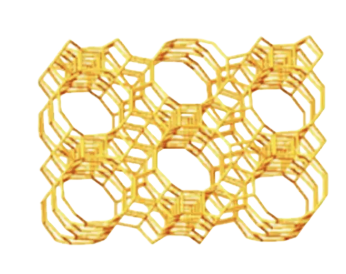
Natural zeolites like clinoptilolite and modernite are widely used. They are mined from geological deposits, crushed, and used as adsorbents. Advantages include low cost, high cation selectivity, and environmental safety.
Applications:
Municipal wastewater treatment
Groundwater purification
Grey water and drinking water treatment
High-silica zeolites have very small pores, usually <1 nm. This allows them to selectively adsorb organic micropollutants (OMPs) such as pharmaceuticals and endocrine disruptors.
Benefits over activated carbon:
Most NOM molecules are too large to enter pores, reducing competition.
They can be regenerated in situ using oxidative methods, avoiding off-site, energy-intensive thermal treatment.
Selectivity can be optimized by matching pore size to pollutant molecule size.
Zeolites can be chemically modified to enhance adsorption. Common modifications include:
Acid treatment: improves heavy metal adsorption.
Metal-loading: Fe³⁺, Al³⁺, La³⁺, or Zr⁴⁺ ions improve anion removal.
Surfactant coating: allows adsorption of negatively charged ions like arsenates and chromates.
| Type | Target Pollutants | Key Advantages | Typical Use |
|---|---|---|---|
| Natural (clinoptilolite) | Heavy metals, ammonium | Cheap, safe, selective | Wastewater, groundwater |
| High-Silica | Organic micropollutants (OMPs) | Small pores, selective adsorption | Drinking water, OMP removal |
| Modified Zeolite | Arsenates, fluorides | Improved anion adsorption | Industrial, municipal water |
pH significantly affects ion exchange efficiency.
High ionic strength or competing ions can reduce removal efficiency.
NOM can block pores if particle size is not matched.
Particle size influences surface area and contact with water.
Pore size and volume control selectivity.
Mechanical strength is critical for column operations.
Contact time determines the degree of pollutant removal.
Temperature and pressure influence adsorption kinetics.
Column operation ensures continuous flow, batch is easier for lab-scale testing.
Industrial wastewater often contains heavy metals such as Zn, Pb, Cu, Cd, Fe, and Mn, which pose significant environmental and health risks. Zeolites, with their unique ion-exchange properties, effectively capture these metals and significantly reduce the toxicity of the wastewater. This makes zeolites a viable alternative to conventional methods like chemical precipitation, coagulation-flocculation, and membrane filtration. Moreover, modified zeolites can also remove organic pollutants, such as dyes and pharmaceutical residues, thereby enhancing the overall efficiency of wastewater treatment processes.
Zeolites play a crucial role in the treatment of surface and groundwater by removing contaminants like ammonia, humic acids, Fe²⁺, and Mn²⁺. In groundwater, common issues include elevated levels of arsenic and fluoride, which can have detrimental effects on human health. Zeolite adsorption technology has proven effective in reducing arsenic levels below the World Health Organization (WHO) limits, ensuring safer drinking water. Additionally, high-silica zeolites are particularly efficient at removing trace organics, even in the presence of natural organic matter (NOM), which often interferes with other treatment methods.
In drinking water treatment, systems combining clinoptilolite and iron (Clinoptilolite-Fe) have demonstrated the ability to remove multiple contaminants simultaneously, including Cu, Zn, and Mn, thereby enhancing water quality. Grey water, which contains significant amounts of ammonium from sources like showers and laundry, can also be effectively treated using zeolites. These materials can remove up to 97% of ammonium, significantly reducing the pollutant load. Furthermore, modified zeolites are capable of capturing fluoride and nitrate even at high concentrations, making them a valuable tool in ensuring the safety and quality of drinking water.

Zeolites offer significant advantages in terms of sustainability and cost-effectiveness due to their ability to be regenerated multiple times, unlike many other adsorbents that degrade after a single use. This regenerability makes zeolites a highly attractive option for long-term, eco-friendly water treatment solutions.
In-situ regeneration: Zeolites can be regenerated directly within their operational environment using oxidative methods. These techniques restore the adsorption sites without the need to remove the zeolite from its installation, thereby minimizing downtime and operational disruption. This in-situ approach is particularly beneficial for large-scale applications where removing and replacing adsorbents would be both labor-intensive and costly.
Desorption: During the regeneration process, the adsorbed metals can be desorbed and recovered. This not only reactivates the zeolite for further use but also allows the recovered metals to be reused in industrial processes. The ability to reclaim valuable metals such as zinc, lead, and copper enhances the economic viability of using zeolites and contributes to a more circular economy.
Environmental benefits: The regeneration of zeolites on-site avoids the energy-intensive and often logistically challenging off-site regeneration processes required for other materials like activated carbon. This reduces the overall carbon footprint associated with water treatment operations and aligns with broader environmental sustainability goals.
Recovered metals as resources: The metals recovered from zeolites can be reintroduced into production cycles, for example, as cathode materials in battery manufacturing. This not only conserves natural resources but also reduces the demand for virgin materials, further supporting the principles of a circular economy.
Pollutants as economic assets: By transforming pollutants into economically valuable resources, zeolite-based treatment systems contribute to a more sustainable and resource-efficient approach to water management. This dual benefit of pollution reduction and resource recovery is a hallmark of sustainable industrial practices.
Reduced costs and impact: The reuse of zeolites significantly lowers operational costs associated with purchasing new adsorbents and disposing of spent materials. Additionally, the reduced environmental impact from decreased waste and lower energy consumption makes zeolites a highly sustainable choice for modern water treatment facilities.
The future of zeolite-based water treatment holds significant promise as researchers and industry leaders continue to innovate and expand their applications. One key direction involves the development of chemically and physically stable modified zeolites, which can withstand harsh treatment conditions and maintain their effectiveness over extended periods. These advanced materials will be particularly focused on targeting organic micropollutants, pharmaceutical residues, and persistent pesticides—contaminants that are increasingly prevalent in water sources but challenging to remove using conventional methods.
Another exciting area of development is the integration of zeolites with other advanced water treatment technologies. Combining zeolites with membranes or incorporating them into advanced oxidation processes can enhance overall treatment efficiency and address a broader range of contaminants. This synergistic approach aims to leverage the unique adsorption properties of zeolites alongside the high separation efficiency of membranes or the powerful oxidizing capabilities of advanced oxidation processes.
These advancements present numerous opportunities across various sectors. Zeolite-based water purification systems offer cost-effective and highly selective solutions for removing specific contaminants, making them ideal for both large-scale industrial operations and smaller household applications. The ability to recover and reuse adsorbed metals not only reduces operational costs but also aligns with circular economy principles, promoting sustainability.
Zeolites are natural or synthetic aluminosilicates with a microporous structure that trap ions and molecules through ion exchange and adsorption.
Zeolites can remove heavy metals, ammonium, fluoride, nitrates, and organic micropollutants like pharmaceuticals and pesticides.
Ion exchange replaces naturally occurring cations in zeolite with pollutants, while adsorption physically traps molecules within the micropores.
Yes, natural zeolites like clinoptilolite are cost-effective, environmentally safe, and highly selective for cations such as ammonium and heavy metals.
pH, ionic strength, and competing ions can affect ion exchange efficiency, while natural organic matter may block pores and reduce adsorption.
Zeolites have proven to be highly effective in water purification, offering selective removal of heavy metals, ammonium, fluoride, nitrates, and trace organic micropollutants. Their unique microporous structure, ion exchange capacity, and regenerability make them a sustainable and cost-effective solution for municipal, industrial, and household water treatment.
Shandong Yutai Chemical Co., Ltd. specializes in the production of high-quality natural and synthetic zeolites. With decades of experience, Yutai provides customized solutions for industrial and municipal water treatment, ensuring consistent performance, high adsorption efficiency, and long-term sustainability. Their products are engineered to meet specific purification needs, from heavy metal removal to organic micropollutant adsorption, helping industries and communities maintain safer, cleaner water.


